
HydraFacial vs Chemical Peel: Which Treatment Is Right for Your Skin?
If you’re looking for a professional treatment to improve dullness, uneven texture, pigmentation or clogged pores, you may find yourself comparing two popular options: HydraFacial and chemical peels.
Both treatments can improve the appearance of the skin, but they work in very different ways. A HydraFacial combines cleansing, exfoliation, extraction and hydration using a specialised device, while a chemical peel uses a carefully selected chemical solution to exfoliate the skin to a controlled depth.
So, which is better?
There isn’t one answer that applies to everyone. The right treatment depends on what you want to improve, your skin type, how sensitive your skin is, your tolerance for downtime and whether you have an underlying skin condition.
This guide explains the difference between HydraFacial and chemical peels so you can have a more informed conversation with your dermatologist.
HydraFacial vs Chemical Peel: Quick Comparison
| HydraFacial | Chemical Peel | |
| How it works | Device-based cleansing, exfoliation, extraction and hydration | Controlled chemical exfoliation |
| Main focus | Hydration, radiance, congestion and surface texture | Pigmentation, acne, texture, sun damage and selected signs of ageing |
| Downtime | Usually minimal or none | Depends on peel depth |
| Sensation | Mild suction and exfoliation | Tingling, warmth or stinging may occur |
| Best suited for | Skin refresh and maintenance | Specific concerns requiring controlled exfoliation |
| Customisation | Boosters and treatment settings can be adjusted | Acid, concentration and depth are selected according to the concern |
| Medical assessment | Recommended when treating skin concerns | Particularly important before a chemical peel |
In simple terms: HydraFacial is generally a gentler, hydration-focused treatment, while chemical peels offer controlled chemical exfoliation that can be tailored to specific concerns.
What is a HydraFacial?
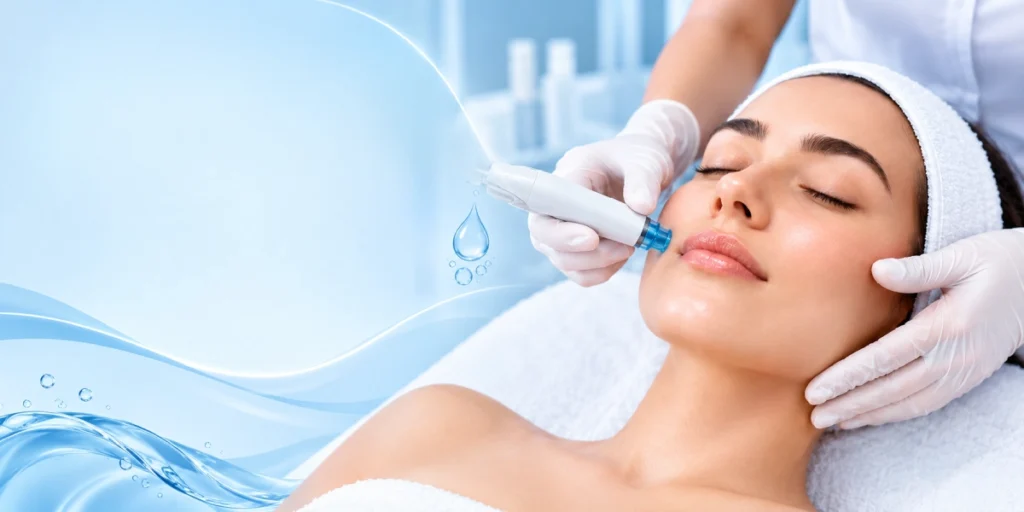
A HydraFacial is a non-invasive professional skin treatment that uses patented Vortex-Fusion® technology to cleanse, exfoliate, extract and hydrate the skin in a single treatment. Depending on the protocol, treatment can also be customised with boosters and other features.
During treatment, a specialised tip moves across the skin while controlled fluid flow and suction help remove surface impurities and deliver selected treatment solutions.
HydraFacial is commonly chosen by people who want to improve the appearance of:
- Dull or tired-looking skin
- Dehydrated skin
- Uneven skin texture
- Congested pores
- Excess surface oil
- Mild unevenness in skin tone
- Fine lines and early signs of ageing
Because it generally involves little recovery time, it can also be appealing when someone wants a quick skin refresh before an event.
Read our detailed guide: What Is HydraFacial? A Complete Beginner’s Guide
What is a Chemical Peel?
A chemical peel is a dermatological treatment in which a chemical solution is applied to the skin to produce controlled exfoliation.
The type of chemical used, its concentration and how long it remains on the skin determine the depth and intensity of the peel.
Common peeling agents include ingredients such as:
- Glycolic acid
- Salicylic acid
- Lactic acid
- Trichloroacetic acid (TCA)
Chemical peels can be superficial, medium-depth or deep. Different depths are used for different concerns, and recovery time varies accordingly.
Depending on the formulation and treatment plan, dermatologists may use chemical peels to address concerns such as certain types of acne, uneven pigmentation, dullness, rough texture, sun damage and some fine lines.
This is why calling every chemical peel a “strong” treatment is misleading. A superficial peel and a deeper peel are very different procedures.
HydraFacial vs Chemical Peel: What Is the Difference?
1. How Do They Work?
The biggest difference is the mechanism of treatment.
HydraFacial uses device-assisted cleansing, exfoliation, extraction and hydration. The treatment is designed to remove surface impurities while simultaneously delivering treatment solutions.
Chemical peels rely on a chemical solution to create controlled exfoliation of the skin. Depending on the formulation and depth, the treatment can affect different layers of the skin.
Neither approach is automatically better. They are simply designed to address different needs.
2. Which Has More Downtime?
Downtime depends on the treatment protocol.
HydraFacial typically requires little to no downtime, although temporary redness or sensitivity can occur in some people.
Chemical peel downtime varies considerably. A superficial peel may cause mild redness and peeling, while deeper peels can involve more significant healing. The American Academy of Dermatology notes that healing time can range from around a day for some superficial “lunchtime” peels to two weeks or longer for deep peels.
Therefore, it is not accurate to say that every chemical peel causes several days of peeling.
Your dermatologist should tell you what to expect from the specific peel being recommended.
3. Which Treatment Is More Comfortable?
HydraFacial is generally comfortable. Most patients notice the sensation of gentle suction and exfoliation as the device moves over the skin.
A chemical peel can produce warmth, tingling or stinging while the solution is applied. The intensity depends on the chemical, concentration, peel depth and individual sensitivity.
If comfort and minimal recovery are your priorities, HydraFacial may be more appealing.
HydraFacial vs Chemical Peel for Different Skin Concerns
The most useful way to compare these treatments is to look at the concern you actually want to address.
HydraFacial for Dehydrated or Dull Skin
If your primary concern is skin that feels dry, looks tired or lacks radiance, HydraFacial may be a suitable option.
Its combination of exfoliation and hydration can leave the skin looking fresher and feeling smoother after treatment.
A chemical peel may also improve dullness, but the appropriate peel needs to be selected according to your skin condition and goals.
HydraFacial vs Chemical Peel for Acne
This requires a little more care.
HydraFacial may help with surface congestion and clogged pores, but it should not be considered a replacement for medical acne treatment.
Certain chemical peels, including salicylic-acid-based peels, may be used as part of an acne treatment plan. However, the appropriate option depends on the type and severity of acne.
If you have persistent inflammatory acne, it is better to see a dermatologist rather than choosing a facial treatment based only on its popularity.
HydraFacial vs Chemical Peel for Pigmentation
Chemical peels can be used to address certain forms of pigmentation and uneven skin tone.
However, pigmentation is not one single condition.
Post-acne marks, sun-induced pigmentation and melasma can require very different approaches.
This is particularly important for Indian and other brown skin tones because inappropriate exfoliation or treatment can sometimes trigger post-inflammatory pigmentation or other colour changes. The AAD recommends seeing a dermatologist experienced in treating skin of colour when considering chemical peels or similar procedures.
So, if pigmentation is your main concern, diagnosis should come before treatment selection.
HydraFacial vs Chemical Peel for Acne Scars
Neither treatment should be presented as a universal solution for acne scars.
Acne scars can be depressed, raised or associated with changes in skin colour. The treatment depends on the type of scar.
A chemical peel may have a role in treating some superficial acne-related changes, but established acne scars often require a more specific treatment plan.
Depending on the scar type, your dermatologist may consider treatments such as microneedling, laser procedures, subcision, chemical reconstruction techniques or a combination approach.
HydraFacial is generally better viewed as a skin-maintenance or surface-refreshing treatment rather than a dedicated acne-scar treatment.
Is HydraFacial Safer Than a Chemical Peel for Sensitive Skin?
Not necessarily in every situation.
HydraFacial is generally a gentler option because it does not rely on a chemical peel to create controlled injury to the skin. However, sensitive or reactive skin can still respond differently to suction, exfoliation or treatment solutions.
Chemical peels can also be safely performed in many people with sensitive or darker skin when the correct formulation and technique are selected by an experienced professional. However, there is a risk of pigmentary changes and other complications if the treatment is inappropriate or poorly performed.
If you have rosacea, eczema, active irritation or unusually reactive skin, speak with a dermatologist before choosing either procedure.
Can You Have HydraFacial and a Chemical Peel Together?
Sometimes, but not automatically and not simply because combining treatments sounds more effective.
The original sequence suggested chemical peel first and HydraFacial immediately afterward is not a universal protocol and should not be presented as standard practice.
Combining exfoliating treatments can increase irritation if the skin is not given enough time to recover.
Whether the treatments can be combined depends on:
- The type of chemical peel
- The strength and depth of the peel
- Your skin sensitivity
- Your existing skincare routine
- Any active skin condition
- Other recent cosmetic procedures
A dermatologist should determine whether combination treatment is appropriate and, if so, how the treatments should be spaced.
HydraFacial vs Chemical Peel: Which One Should You Choose?
A simple way to think about the decision is:
Choose HydraFacial when your priority is:
- Hydration
- A temporary skin glow
- Gentle exfoliation
- Surface congestion
- Smoother-feeling skin
- Minimal recovery time
- Regular skin maintenance
Consider a chemical peel when your dermatologist recommends it for:
- Certain types of pigmentation
- Some forms of acne
- Sun-damaged skin
- Rough or uneven texture
- Selected fine lines
- Other concerns that may respond to controlled chemical exfoliation
But these are general guidelines, not a substitute for a skin assessment.
Your dermatologist may recommend a completely different procedure depending on what they find during your consultation.
Which Treatment Is Better Before an Event?
If you have an important event coming up and want a temporary improvement in radiance with minimal recovery, HydraFacial may be the more convenient option.
Chemical peels require more planning because the amount of redness or peeling depends on the type and depth of the peel.
If you’ve never had a particular peel before, it is generally not a good idea to experiment with an unfamiliar treatment immediately before an important event.
HydraFacial vs Chemical Peel: Cost in India
The cost of both treatments varies considerably across India.
Pricing can depend on:
- City and clinic
- Type of HydraFacial protocol
- Boosters or add-ons
- Type and strength of chemical peel
- Number of sessions recommended
- Dermatologist’s expertise
Instead of choosing solely on price per session, consider the complete treatment plan and whether the recommended procedure actually addresses your concern.
For more information, see our guide to HydraFacial Price in India.
So, Which Is Better: HydraFacial or Chemical Peel?
Neither treatment is universally better.
HydraFacial may be the better fit if your priority is hydration, surface exfoliation, congestion, radiance and minimal downtime.
A chemical peel may be more appropriate when a dermatologist wants to use controlled chemical exfoliation for a specific concern such as certain types of acne, pigmentation, sun damage or uneven texture.
And sometimes, neither is the right first choice.
For example, persistent acne, melasma, significant acne scarring or a chronic skin condition may require medical treatment rather than a cosmetic facial procedure.
The best treatment is therefore not the one that is most popular, it is the one that is appropriate for your skin and your specific concern.
Get a Personalised Skin Assessment at Isaac Luxe
At Isaac Luxe, we believe treatment should begin with understanding your skin rather than choosing a procedure from a menu.
Our dermatologist-led consultations assess your skin type, current concerns, medical history and treatment goals before recommending an appropriate approach.
Depending on your needs, that may include HydraFacial, a chemical peel, another dermatological procedure or a combination treatment plan.
Isaac Luxe offers dermatology and aesthetic treatments across Delhi NCR, Gurgaon, Mumbai, Bangalore, Hyderabad and Mohali, Punjab.
Explore HydraFacial at Isaac Luxe
Explore Chemical Peel Treatment at Isaac Luxe
Frequently Asked Questions
Which is better, HydraFacial or chemical peel?
It depends on your skin concern. HydraFacial is generally suited to hydration, gentle exfoliation, congestion and a temporary refreshed appearance, while chemical peels can be selected for specific concerns such as certain types of acne, pigmentation, sun damage and uneven texture.
Is HydraFacial safer than a chemical peel?
Both can be safe when appropriately selected and performed by trained professionals. HydraFacial is generally less intensive, but suitability still depends on your skin. Chemical peels carry risks such as irritation and pigmentary changes, particularly when the wrong peel or technique is used.
Which is better for pigmentation: HydraFacial or chemical peel?
Certain chemical peels may be more appropriate for some pigmentation concerns, but the cause of pigmentation should be diagnosed first. Melasma, post-acne pigmentation and sun-related pigmentation require different treatment strategies.
Which is better for acne: HydraFacial or chemical peel?
It depends on the type of acne. Some chemical peels may be used as part of an acne treatment plan, while HydraFacial may help with surface congestion. Persistent or inflammatory acne should be evaluated by a dermatologist.
Does a chemical peel have more downtime than HydraFacial?
Generally, chemical peels can involve more downtime, but this depends on the depth of the peel. Some superficial peels have minimal recovery, while deeper peels require significantly longer healing.
Can I get HydraFacial and a chemical peel on the same day?
Do not combine them without professional advice. Both treatments can exfoliate the skin, and combining them may increase irritation depending on the protocol. Your dermatologist should decide whether they can be combined and how they should be scheduled.
Is HydraFacial good for sensitive skin?
HydraFacial may be suitable for some people with sensitive skin, but sensitive or reactive skin should still be assessed before treatment. The treatment can be adjusted according to skin tolerance.
Sources and References
- American Academy of Dermatology (AAD) – Chemical Peels: FAQs
- American Academy of Dermatology (AAD) – Chemical Peels: Overview
- American Academy of Dermatology (AAD) – Chemical Peel Preparation
- DermNet – Chemical Peels
- HydraFacial – Official Treatment Information
- HydraFacial – Frequently Asked Questions
Medical disclaimer: This article is intended for general educational purposes and does not replace an in-person consultation with a qualified dermatologist. A dermatologist should assess your skin and medical history before recommending a cosmetic or dermatological procedure.